
Maksym Stepanenko
Managing Partner, Crystal Tax
International client projects since 2012: company structures, tax, immigration, DUNS and NCAGE. 50+ jurisdictions.
Trademark registration in Canada, turnkey: we check your mark, draft the list of goods and services in Nice classes and take the CIPO application through to registration via a licensed Canadian trademark agent.
Since 2012 · 50+ jurisdictions · direct CIPO filing or the Madrid System · trademark and Canadian company in one team
In brief
Pick the situation closest to yours: a short note on the route and the first step.
We check whether the mark is available in Canada, draft the goods list around your actual range and file with CIPO. Amazon Brand Registry works with registered or pending marks; we check the requirements for the specific store in Seller Central, so the Canadian application goes in before sales start.
Example. A homeware manufacturer from Lviv filed a CIPO application in two classes before launching on Amazon.ca, preparing the listings in parallel.
Discuss this case →We compare two routes: designating Canada in an international application under the Madrid System, or a national application with CIPO. If a national application abroad was filed less than six months ago, we claim Convention priority, and the first filing date counts as the filing date in Canada.
Example. The owner of an EU trademark for cosmetics extended protection to Canada through the Madrid System, and the response to CIPO's provisional refusal was filed through a partner Canadian agent.
Discuss this case →Incorporation secures the corporate name in the corporate registry, while the right to the brand comes from trademark registration with CIPO. We check the name as a mark and file for the goods and services under which the company reaches its customers.
Example. The founders of an IT service incorporated in Ontario and then filed for a word mark and a logo in software and services classes.
Discuss this case →We analyse the objections: confusion with another mark, descriptiveness, an overly general goods list. A licensed partner trademark agent in Canada prepares and files the response; we control the strategy and deadlines.
Example. An examiner found the name of a coffee brand descriptive; after the goods list was clarified and distinctiveness arguments were filed, the application was approved for advertisement.
Discuss this case →We assess the opponent's grounds and your chances and propose options: narrow the goods list, agree coexistence of the marks, or defend before the Trademarks Opposition Board. The partner agent runs the proceeding; we handle communication with you and budget decisions.
Example. The owner of a similar footwear mark opposed an application for a clothing brand; after the goods list was narrowed, the parties signed a coexistence agreement.
Discuss this case →One team handles both countries: a shared search, an aligned goods list and a choice between two national applications and the Madrid System. Details for the US are on the US trademark registration page.
Example. A sports nutrition brand filed national applications with CIPO and the USPTO a few days apart and claimed priority from the first one.
Discuss this case →Turnkey trademark registration in Canada covers the whole path from checking the mark to the registration certificate and ongoing monitoring. By law an owner may file a CIPO application on their own, and only a licensed trademark agent, or a lawyer within the scope of their practice, may represent another person before the office. We work through licensed partner trademark agents in Canada; for the client it is turnkey, and responsibility to the client is ours.

The best time is before your public launch in Canada: before first sales, advertising and marketplace listings. The filing date decides who gets the mark when two applicants claim similar marks. If you already sell, the application is still worth filing: a registered mark gives an exclusive right across Canada, while protecting an unregistered mark means proving reputation and use in every dispute.
For marketplace sales the mark also matters in practice: Amazon Brand Registry works with registered and pending marks, and we check the exact requirements for the specific store in Seller Central at the time of filing.
Usually, in our experience, the search, goods list and filing take 1–2 weeks from signing the contract, while examination and registration in Canada take a long time and depend on CIPO. The timeline depends on the case, its details, the authorities and force majeure.
Usually, in our experience, the path from filing to registration in Canada takes more than a year even without objections. An examiner's report adds time for the response, and an opposition adds several more stages with evidence and written arguments from both sides. The timeline depends on the case, its details, the authorities and force majeure.
An opposition before the Trademarks Opposition Board runs in stages with set deadlines: the applicant files a counter statement, then the opponent files evidence within four months, the applicant files its evidence within another four months, and after that the parties exchange written arguments, two months each. Cross-examination and an oral hearing are possible, and the decision can be appealed to the Federal Court. An opposition therefore adds noticeable time to registration, and in parallel we assess whether a settlement with the opponent is possible.
For Madrid applications CIPO has a hard deadline: a provisional refusal must be sent within 18 months after the notification of territorial extension to Canada.
Priority is easier to protect in advance: the filing date in Canada decides a conflict between two similar applications, so we file before the public brand launch whenever possible.
We calculate the cost of trademark registration in Canada individually: it depends on the number of classes, the depth of the search and how examination goes.
CIPO government fees are paid separately at the official rates; the 2026 amounts are listed in the reference section below. Describe your mark and goods in a few sentences, and we will estimate the work within a working day. For a detailed review of your strategy, a 30-minute consultation is available for 100 euros.
Five reasons brand owners register their trademark in Canada with us.
We work in 50+ jurisdictions; we know the requirements of CIPO, registrars and banks from our own cases, including the rules in force in Canada since the reform of 17 June 2019.
The application and CIPO correspondence are handled by licensed partner trademark agents in Canada; coordination and responsibility to you are ours. We need the mark, details of the goods and decisions from you.
If CIPO sends an examiner's report or a request, we work through it with no extra charge for our support.
Trademark, Canadian company, contracts, taxes and reporting, including Ukrainian CFC (controlled foreign company) reports, with no need to find separate contractors.
We work under a contract with confidentiality terms written into it.
To register a trademark in Canada we go through six steps, and at each one you know what we need from you.
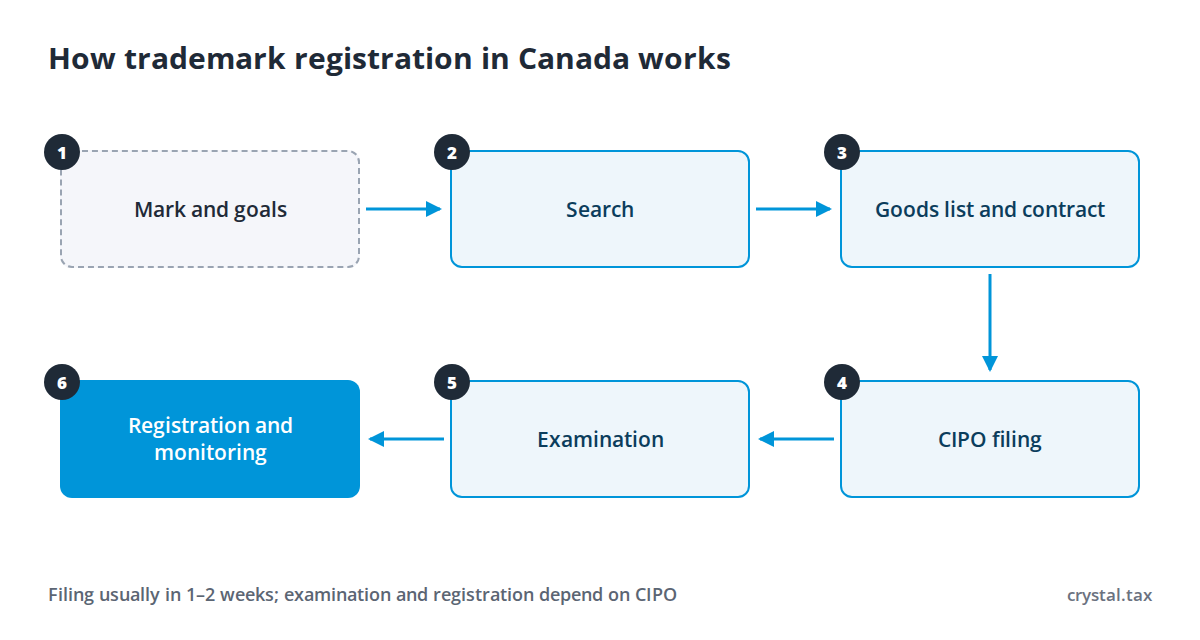
For trademark registration in Canada you need applicant details, an image of the mark and a list of goods and services; the exact list depends on the filing route.
A direct CIPO filing and a designation of Canada in an international application under the Madrid System lead to the same Canadian registration, but differ in basis, timelines and flexibility.
| Criterion | National CIPO application | Madrid System designating Canada |
|---|---|---|
| Base application or registration needed | No | Yes, at the office of origin |
| Where it is filed | Directly with CIPO | Through the office of origin to the WIPO International Bureau |
| Fees | To CIPO in Canadian dollars | To WIPO in Swiss francs, including the individual fee for Canada |
| Examination | Under Canadian law | Also under Canadian law, the application is treated as national |
| CIPO timelines | Target for first decision: 14 months from filing | Target for first decision: 14 months from notification of Canada; provisional refusal no later than 18 months after that notification |
| Dependence on the base mark | None | Five years from the international registration date |
| Renewal | With CIPO every 10 years | Through WIPO together with the international registration |
| Convenient when | Canada is the main market or you need a list tailored to Canada | The mark is already protected at home and you need many countries at once |
A response to a provisional refusal of a Madrid application is filed directly with CIPO, as for a national one. CIPO corresponds with the applicant or with an appointed Canadian trademark agent with an address in Canada, so we prepare examination responses through the partner agent.
CIPO fees are shown in Canadian dollars as published on the office's official page; our services are paid separately.
| Action | 2026 fee, CAD |
|---|---|
| Online application, first class | 491.06 |
| Application, each additional class | 149.04 |
| Application filed by other means, first class | 640.10 |
| Online renewal, first class | 595.06 |
| Renewal, each additional class | 185.49 |
| Filing a statement of opposition | 1,115.08 |
| Request for a section 45 notice on evidence of use | 595.06 |
| Extension of time under section 47 | 150.00 |
From 1 January 2027 some fees rise by 1.7 percent: the online application for the first class will be 499.41 and each additional class 151.57. The amount depends on the date CIPO receives payment. There is no separate registration fee for applications filed on or after 17 June 2019. For Madrid applications fees are paid to WIPO, including the individual fee for Canada.
A CIPO examiner checks each application against the trademark database and the grounds in the Trademarks Act; most objections are predictable, and we account for them at the search stage.
| Ground | What it means | How we reduce the risk |
|---|---|---|
| Confusion | The mark resembles a registered or earlier-filed mark for similar goods or services | Search of the CIPO database, including French variants, adjustment of the goods list, consent of the earlier mark's owner |
| Clearly descriptive | The mark directly describes the character or quality of the goods in English or French | A more distinctive mark, a logo, evidence of distinctiveness |
| Deceptively misdescriptive | The mark misleads about the characteristics of the goods | Checking the mark against the actual product |
| Place of origin | The mark describes the geographic place the goods or services come from | Assessing how a Canadian consumer will perceive the mark |
| Name or surname | The mark consists only of a name or surname | Adding distinctive elements or evidence of recognition |
| Name of the goods in any language | The word means the product itself, for example in Italian or Ukrainian | Linguistic check of the mark before filing |
| Official marks and portraits | The mark resembles an official mark or contains the portrait or signature of a living person or of someone who died within the last 30 years | Checking official mark lists, consents |
| Unclear goods list | Goods are described too generally, without specific commercial terms | A list based on the CIPO Goods and Services Manual |
If the examiner disagrees with the response, CIPO issues a refusal with reasons, which can be appealed to the Federal Court of Canada. In our experience, objections are most often resolved by clarifying the goods list or by the agent's arguments at the examination response stage.
Trademark registration in Canada is governed by the Trademarks Act and the Trademarks Regulations; the key rules have applied since the reform of 17 June 2019.
A corporate name in the corporate registry and a trademark are different rights. According to CIPO guidance, a trade name can be registered as a trademark only if it is used to identify goods or services. A business in Canada usually needs both steps, and the structure as a whole benefits from legal support for international business.
Send us the mark and describe your goods and markets in a few sentences. We reply within a working day, and on a free 10-minute call we tell you which route to trademark registration in Canada suits you.
CIPO — Fees for trademarks; CIPO — Trademarks guide; CIPO — International trademarks under the Madrid Protocol; CIPO — Performance targets 2026–2027; CIPO — Extensions of time in examination (practice notice); Justice Laws — Trademarks Act; Justice Laws — Trademarks Regulations SOR/2018-227; Justice Laws — College of Patent Agents and Trademark Agents Act, ss. 30 and 71; WIPO Lex — treaties in force for Canada; WIPO — Nice Classification, NCL 13-2026. Checked: 27.09.2026.
Maksym Stepanenko
Managing Partner, Crystal Tax
International client projects since 2012: company structures, tax, immigration, DUNS and NCAGE. 50+ jurisdictions.
Briefly describe your task: the country, the business activity and the timing. That is enough for us to propose a solution and the order of work.
We reply within one business day.
Or message us
 Telegram
 WhatsApp