
Maksym Stepanenko
Managing Partner, Crystal Tax
International client projects since 2012: company structures, tax, immigration, DUNS and NCAGE. 50+ jurisdictions.
A business strategy session for owners with Maksym Stepanenko: we review your international structure, entry into new markets, company and owner taxes, and hand you a step-by-step action plan.
Since 2012 · 50+ jurisdictions · action plan after the session · turnkey implementation by one team
In brief
Pick the situation closest to yours: a short note on what we cover in the session and where we start.
We compare two or three EU countries for the company: corporate tax, VAT, bank, director and substance requirements. We calculate the owner's taxes in Ukraine, including the Ukrainian CFC rules, and set out the order of steps.
Example. The owner of an IT company from Dnipro wants to sign contracts with German clients through a European company. In the session we choose the country, allocate contracts and staff and decide what to do before the first invoice to a client.
Discuss this case →We review tax residency under the tests of the Tax Code of Ukraine and of the new country, and what happens to the Ukrainian company and personal accounts. The plan shows what to change right away and what to change after your residency changes.
Example. The owner of a trading company lives in Poland with his family while the business runs in Kyiv. We determine where his centre of vital interests is, how he should receive income and what he must file in each country.
Discuss this case →We map the current ownership chain down to individuals and find redundant links and risks for banks and tax authorities. We propose a target structure, with a holding company if needed, and the order of transitions.
Example. An entrepreneur has three companies in different countries, set up at different times for different projects. We bring them into a clear structure and plan which companies to close and which to transfer to a holding.
Discuss this case →We review the company form, federal and state taxes or UK corporation tax, the bank and payment services. Separately, we work out how profit will reach the owner.
Example. A home goods manufacturer is launching sales on a US marketplace. In the session we choose the company form, the state, the bank and the settlement scheme with the production in Ukraine.
Discuss this case →We check how the structure looks to an investor or buyer: who owns the shares and the intellectual property, where the contracts sit, what reporting exists. The plan shows what to put in order before negotiations.
Example. The founders of a SaaS product are in talks with a fund. We decide in which country the parent company should be, who owns the code and which documents the investor will ask for.
Discuss this case →We invite all partners to the session and review shares, management, partner exit and each partner's taxes in their own country. The agreements are then fixed in a shareholders agreement.
Example. Three partners live in Ukraine, Spain and the UAE and are launching a joint project. We choose the company's country, split the roles and record what goes into the shareholders agreement.
Discuss this case →In a strategy session we cover six topics that shape the international structure of a business: ownership, markets, taxes, banks, people and the order of steps. We agree the agenda, depth and participants before the meeting, so the time goes to your decisions.

Which companies you need, in which countries, who owns them and in what shares, whether a holding company is needed. We draw the ownership chain down to individuals, the way a bank and a tax authority see it. We check where each company is actually managed and whether that creates a taxable presence in another country. If there are several partners, we note what to fix in writing, for example in a shareholders agreement.
The EU, the UK, the US, the UAE and other countries: where to open a company or a branch for your clients, which registrations are needed for sales and hiring, what the bank and the local tax authority require. We also check whether you need a local director, an office or staff for the company to pass bank and tax checks, and how many reporting obligations appear in the first year.
We compare corporate tax in candidate countries, taxes on dividends and salaries, and the owner's personal taxes. For Ukrainian tax residents we separately check the Ukrainian CFC (controlled foreign company) rules, tax residency and the conditions for exempting CFC profit from tax. If there are several owners living in different countries, we calculate each one's taxes, because the same structure gives partners different results.
Where the company's and the owner's accounts will be, which payment services fit the business model, which source-of-funds documents will be needed. The bank decides whether to open an account; our job is to pick realistic options and prepare the application package.
Where the owner and key staff will live, whether a residence permit is needed, and how this affects tax residency and where the company is actually managed.
What could stop the plan: bank requirements, Ukrainian CFC reporting, double taxation, government processing times. For each risk we set an action and its place in the sequence of steps.
The result of the strategy session is an action plan for the owner: which steps to take, in what order, in which jurisdictions, with which documents and who is responsible for what.
We write the plan for the owner: short, step by step, with clear decisions. You can hand it to partners, a CFO or an investor so everyone works from the same structure.
You can implement the plan yourself or hand it to us turnkey: company registration abroad, bank accounts, accounting, Ukrainian CFC reporting and relocation are handled by one team. The plan is then carried out by the same team that helped prepare it.
Describe your business, countries and goal, and on a free 10-minute call we will tell you whether you need a strategy session and what its agenda would include.
A 30-minute consultation suits one scenario or question; a strategy session covers the whole business structure and ends with a written action plan.
| Format | What it is for | Depth | Result |
|---|---|---|---|
| Introduction, 10 minutes, free | Understand whether you need a structure now and where to start | The task in broad terms | Direction and next step |
| Consultation, 30 minutes, €100 | A short paid review of one scenario or question | Jurisdiction and structure options, risks, answers to your questions | A clear view of the options for one scenario |
| Strategy session | The whole business structure: ownership, markets, company and owner taxes, banks, relocation | Set to the task; agenda and participants agreed in advance | Action plan: steps, order, jurisdictions, documents, risks |
If you are unsure, start with the free 10 minutes: from your description we will tell you which format is enough. How our work runs from the first question to a finished structure is described on the page how we work.
We propose the agenda and format of the strategy session within one business day of your request, and agree the meeting date with you and your partners.
Usually, in our experience, the time until the session depends on preparation: how quickly the information on companies, owners, turnover and plans is collected. The fuller the questionnaire, the more precise the agenda and the fewer questions are left for later. We prepare the action plan after the session and name its preparation time when we agree the agenda. Timing depends on the case, its details, the work of the authorities and force majeure.
Implementation runs on its own schedule: company registration, account opening and relocation depend on registries, banks and immigration services. The official deadline of an authority covers only the review of complete documents, so the plan lists the stages and what each of them depends on. If you have an external deadline, such as investor talks, the start of a contract or a family move, mention it in your request: we will build the agenda and the order of steps around that date.
We price each strategy session to the task: the cost depends on the number of countries and companies, the complexity of the current structure and the depth of the plan.
The only published price is the 30-minute consultation at €100; the 10-minute introduction is free. We quote a session within one business day of a short description of your task. The quote lists the agenda topics, the participants and what the written plan will include, so you see the scope of work in advance. Implementation of the plan is quoted separately, per country and service. We work under a contract.
A plan for an international structure makes sense only if it can be carried out, and owners trust us with it for five reasons:
For fourteen years we have been building international structures, registering companies, opening accounts and handling tax matters in 50+ jurisdictions. We know the requirements of registrars, banks and tax authorities from our own cases.
Registrations, bank applications, tax registrations and reporting under the plan are handled by Crystal Tax lawyers and accountants together with partners in each country. We handle correspondence with authorities and banks; you provide documents and decisions.
We resolve registrar and tax authority comments and bank questions on our work at no extra charge.
Structure, companies, accounts, accounting, taxes and Ukrainian CFC matters are handled by one team, so you need no separate contractor for each country.
Scope of work, timing and confidentiality are set out in the contract. We disclose data about you, your partners and companies only to the extent the procedure requires.
A strategy session has six steps, from request to implementation. We need information about the business and your decisions; we take care of the preparation and the plan.
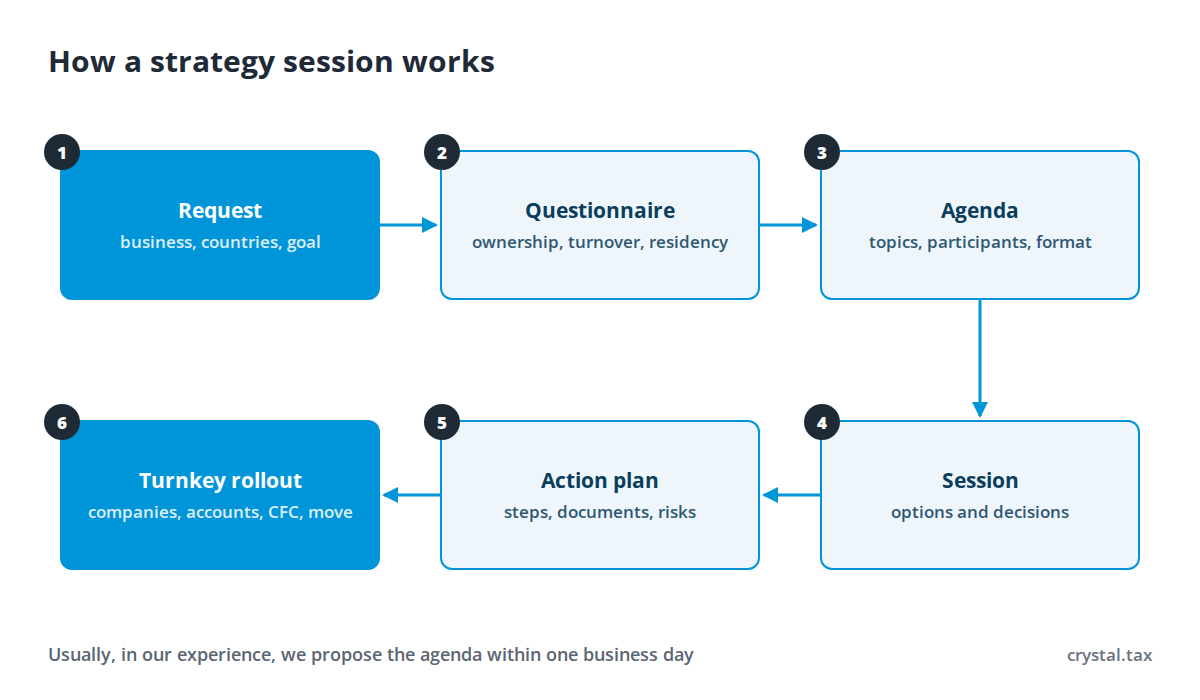
For the session it is enough to gather information about the current business and your goals: we clarify the rest through the questionnaire.
If some information is missing for now, note it in the questionnaire: we can cover part of the questions at the meeting itself. We use the data only to prepare the session; confidentiality terms are set out in the contract.
If the owner of a foreign company is a Ukrainian tax resident, they are subject to the controlled foreign company rules of Article 39-2 of the Tax Code of Ukraine, and we account for these rules in any plan.
We prepare the notices and reports as part of our Ukrainian CFC reporting service.
Corporate tax is one of the figures we use to compare countries in the session, together with the owner's taxes, bank requirements and the Ukrainian CFC rules.
| Country | Corporate tax rate | Conditions |
|---|---|---|
| United Kingdom | 25 percent, 19 percent for small profits | 19 percent for profits up to 50,000 pounds, 25 percent above 250,000 pounds, marginal relief in between. Financial year from 1 April 2026 |
| UAE | 0 and 9 percent | 0 percent on taxable income up to 375,000 dirhams, 9 percent on the amount above it |
| Estonia | 22/78 | Tax is paid on profit distribution: 22/78 of the net payout, that is 22 percent of the gross amount. The reduced 14/86 rate for regularly paid dividends was abolished from 1 January 2025 |
| Poland | 19 percent, reduced 9 percent | 9 percent for small taxpayers and companies in their first year of activity with annual revenue up to 2 million euros |
| United States | 21 percent | Federal corporate income tax, excluding state taxes |
For comparison, the basic corporate tax rate in Ukraine is 18 percent. The 15 percent global minimum tax under the OECD model rules applies to multinational groups with annual consolidated revenue of 750 million euros or more. We check the rate for your country as of the session date.
Write two or three sentences on what the business does, in which countries the companies and owners are, and what decision you expect. Within one business day we will propose the agenda, format and participants of the strategy session and quote the cost. If you would like to get acquainted first, book the free 10 minutes. For a short review of one question, a 30-minute consultation for €100 is enough.
Tax Code of Ukraine, Articles 14.1.213, 39-2, 49.18, 136, 167, Subsection 10 of Section XX, version of 17.09.2026; OECD: MCAA CRS signatories and intended first exchange date; GOV.UK: Rates and allowances, Corporation Tax; UAE Ministry of Finance: Federal Decree-Law No. 47 of 2022, Corporate Tax; UAE Ministry of Finance: Cabinet Decision No. 116 of 2022; UAE Ministry of Finance: Top-up Tax; Estonian Tax and Customs Board: tax rates 2026; Podatki.gov.pl: CIT, stawki i limity; 26 U.S. Code § 11, tax imposed on corporations; IRS: Instructions for Form 1120. Reviewed and updated on 27.09.2026.
Maksym Stepanenko
Managing Partner, Crystal Tax
International client projects since 2012: company structures, tax, immigration, DUNS and NCAGE. 50+ jurisdictions.
Briefly describe your task: the country, the business activity and the timing. That is enough for us to propose a solution and the order of work.
We reply within one business day.
Or message us
 Telegram
 WhatsApp