
Maksym Stepanenko
Managing Partner, Crystal Tax
International client projects since 2012: company structures, tax, immigration, DUNS and NCAGE. 50+ jurisdictions.
UK company formation for non-residents, turnkey: we register your LTD remotely, complete Companies House identity verification, provide a UK registered office and prepare the company for the bank and for reporting.
Since 2012 · 50+ jurisdictions · fully remote, no trip to London · Ukrainian CFC reporting in the same team
Watch the video with chapters and a summary · 1:16
In brief
Pick the situation closest to yours: a short outline of the route and the first step.
We register the LTD remotely, run identity verification with your passport and provide a registered office. We agree up front where the company will be managed and set up your Ukrainian CFC report from day one.
Example. The owner of an IT studio from Lviv opened an LTD for contracts with clients in Germany and the Netherlands; one team handles the UK filings and the CFC report.
Discuss this case →We register the LTD, check whether VAT registration is needed from the first sales and prepare the documents for verification on the marketplace and with the payment provider.
Example. A homeware manufacturer from the Kyiv region opened a company for sales in the UK and registered for VAT straight away.
Discuss this case →A shelf company saves a few days and helps when you need an earlier incorporation date. We check its history, filings and debts; the new director and owner still go through identity verification.
Example. A client needed a company with a track record for a tender; after checking two options they chose a new registration, because the shelf company had overdue filings.
Discuss this case →We find out why the account was closed, put the documents, the PSC details at Companies House and the filings in order, then apply to banks and payment institutions that accept this profile.
Example. A consulting LTD lost its account after a source of funds request; once the file was prepared, the company opened an account with an electronic money institution.
Discuss this case →We complete verification through One Login or an authorised provider, file the personal code of each director and PSC and update the confirmation statement.
Example. The owner of a company incorporated in 2019 received a warning before the confirmation statement was due; verification was closed within a few days.
Discuss this case →We design the structure: who owns the LTD, where it is managed and how dividends are paid. We take into account the CFC rules and the tax residence of the company.
Example. The owners of a manufacturing business set up a UK holding company to bring in an investor and calculated the taxes in both countries in advance.
Discuss this case →Turnkey UK company formation for non-residents covers everything a working LTD needs, from structure and verification to tax registration and bank preparation. You send documents and make decisions, and we do the rest.

The bank account is the hardest part when you open a UK company with no UK residents involved. Traditional UK high street banks often require the director or owner to live in the UK, or expect an in-person visit and a trading history. For non-residents, the realistic first step is an electronic money institution (EMI) or a digital bank that opens accounts remotely; moving to a traditional bank comes later, once the company has filed accounts and signed contracts.
You can buy a UK company: a shelf LTD registered earlier without any activity is transferred to the new owner and director. This makes sense when a counterparty or a tender requires a company with an earlier incorporation date. For a normal start, a new registration is simpler: it has a clean history, and new directors and PSC go through identity verification in either case. Before a purchase we check the register, the filed accounts, any debts to HMRC and the history of changes.
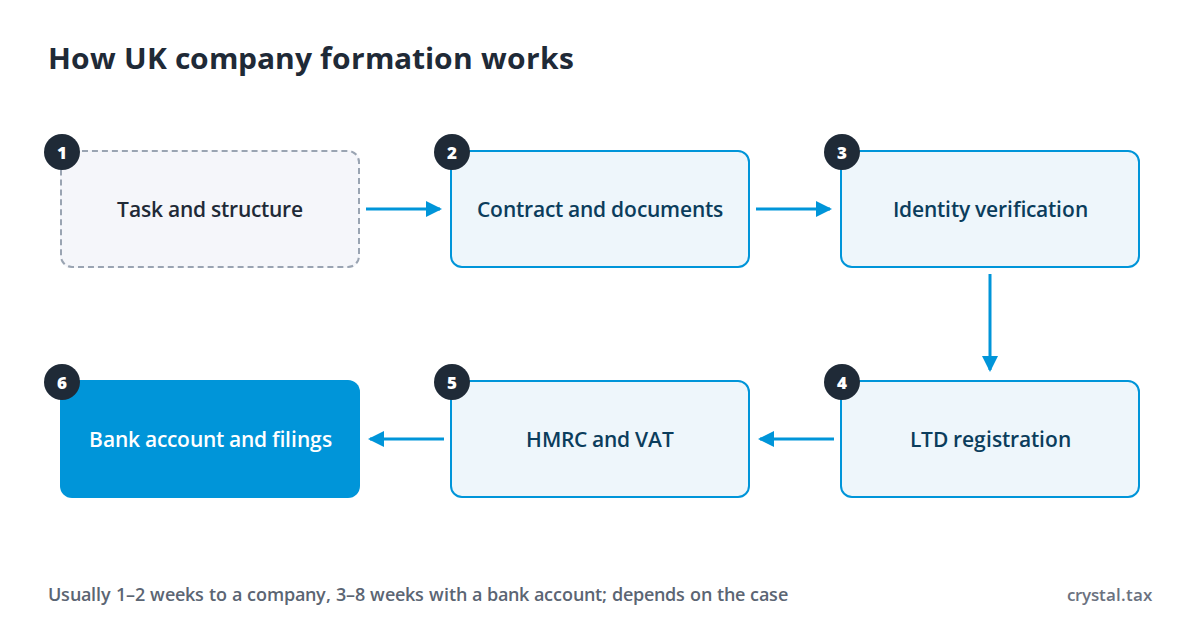
Usually, in our experience, registering a UK company with verification and an address takes 1–2 weeks from signing the contract, and the full launch including a bank account takes 3–8 weeks. The timeline depends on the case, its details, the work of the authorities and force majeure.
The registrar's official turnaround covers only the review of a completed application. Time for preparing documents, verification and bank checks comes on top of that.
Timelines get longer in predictable cases: the owner is a company from another country and documents are needed for the whole chain; the director has a passport the One Login app cannot read; the business involves payments, crypto assets or dual-use goods, and the bank carries out enhanced checks. We point these out at the start so you can plan the launch with a margin.
After registration the company has its own dates: the first confirmation statement, the first annual accounts 21 months after incorporation, and notifying HMRC that the company is active for Corporation Tax within 3 months of starting to trade. We hand over a calendar with these dates together with the company documents.
We price UK company formation individually: the cost depends on the structure, the number of participants and what you need beyond the LTD itself.
Companies House government fees are paid separately at the official rate: as of 27.09.2026, online incorporation costs 100 pounds and the annual confirmation statement filed online costs 50 pounds. Third-party costs, such as ACSP services for verification or document translation, are agreed in advance. Annual maintenance of the company includes the address, accounting and filings; we estimate their scope from the start, so your first-year budget is clear before registration. Describe your task in a few sentences, and we will estimate the work within one working day. If you need a detailed review of the structure, there is a 30-minute consultation for 100 euros.
Five reasons business owners open a company in England with us.
We work in 50+ jurisdictions and know the requirements of Companies House, HMRC and UK banks from our own cases, including the changes of 2024–2026.
Correspondence with Companies House, HMRC and the bank and answers to their requests are our job. From you we need documents and decisions.
If the registrar, the tax office or the bank sends remarks, we rework them at no extra charge.
Company, address, bank account, accounting, UK taxes and Ukrainian CFC reporting, with no need to look for separate contractors.
We work under a contract, and the confidentiality terms are written into it.
UK company formation runs in six steps, and at each one you know what is needed from you.
For UK company formation, a non-resident needs a passport, proof of address and a clear description of the business; an apostille and notarised copies are usually not required for registration with Companies House.
Banks and payment institutions may ask for more: the owner's CV, proof of source of funds, tax residence. We confirm the list for the specific bank.
The Economic Crime and Corporate Transparency Act 2023 (ECCTA) introduced new mandatory requirements for every UK company, the first of them in force since 4 March 2024.
For an owner from Ukraine this means a simple rule: the company details must match reality, and the address and email must work. Both the registrar and the bank notice errors on the register.
| What | Who files and where | Deadline |
|---|---|---|
| Confirmation statement | Companies House | At least once a year, within 14 days after the end of the 12-month review period |
| First annual accounts | Companies House | 21 months from the date of incorporation |
| Subsequent annual accounts | Companies House | 9 months after the end of the financial year |
| Registration for Corporation Tax | HMRC | Within 3 months of starting business activity |
| Corporation Tax payment | HMRC | Usually 9 months and 1 day after the end of the accounting period |
| CT600 return | HMRC | 12 months after the end of the accounting period |
Corporation Tax rates for the 2025 and 2026 financial years: 19 percent on profits up to 50,000 pounds, 25 percent on profits over 250,000 pounds, and between the thresholds the main rate with marginal relief. If there are associated companies, the thresholds are divided by their number including the company itself, and they are reduced proportionally for a period shorter than 12 months.
VAT: registration is mandatory when taxable turnover over 12 months exceeds 90,000 pounds or is expected to exceed it in the next 30 days. The CT600 return is filed even when the company makes a loss. From 1 April 2028, annual accounts can be filed with Companies House only through commercial software in iXBRL format.
We take over bookkeeping and all filings as part of the company's accounting support.
A company incorporated in the UK is UK tax resident by default and pays Corporation Tax on all its profits. For companies incorporated in other countries, HMRC applies the central management and control test: residence is where key decisions are actually made.
If the LTD owner is a Ukrainian tax resident and controls the company, the owner has obligations under the Ukrainian CFC (controlled foreign company) rules: an annual CFC report to the Ukrainian tax authority and a calculation of adjusted profit. Some companies qualify for exemptions, and whether they apply depends on the structure and the figures. We assess this before registration and prepare the report together with the UK accounts.
| Question | United Kingdom | Ukraine |
|---|---|---|
| Who pays tax on LTD profits | The company itself, Corporation Tax | The owner under the CFC rules, unless an exemption applies |
| What is filed | Annual accounts, confirmation statement, CT600 | CFC report together with the annual tax return |
| What to consider | Where decisions are made, directors' residence | Shareholding and control, dividends, double taxation |
A UK company suits you when you need a reputation that European and British partners understand, a public register and a standard tax system. If your clients are mostly in the US or you need a different tax model, we compare options as part of our company formation abroad service.
Opening a company in the UK makes sense if you have clients or partners in the UK and Europe, need a company for contracts with large customers, marketplaces or bringing in an investor, and are ready for a public register and regular filings. A UK LTD is a poor fit for hiding the owner or avoiding tax: the names of directors and PSC are visible on the public register, and tax residence depends on where the company is actually managed.
If the company is in fact managed from Ukraine and the director also lives there, there is a risk that Ukraine will treat the company as its own tax resident. That is why before registration we look at who makes decisions, where board meetings take place and how this is reflected in the documents.
| Criterion | UK LTD | US LLC |
|---|---|---|
| Register | Public, directors and PSC are visible | Depends on the state |
| Tax at company level | 19–25 percent Corporation Tax | Depends on the LLC's tax status |
| Owner verification | Mandatory at Companies House | Checks by the bank and the registered agent |
| Best suited for | Work with the UK and Europe | Work with the US market, US marketplaces |
Describe your task in a few sentences: what the business does, who the owners are and where the clients are. We reply within one working day, and on a free 10-minute call we will tell you right away whether a UK company suits you.
GOV.UK — Verifying your identity for Companies House; GOV.UK — Corporation Tax: trading and non-trading (notifying HMRC within 3 months); GOV.UK — Registered office and email address; GOV.UK — Confirmation statement guidance; GOV.UK — Companies House confirms identity verification rollout from 18 November 2025; HMRC — Rates and allowances: Corporation Tax; GOV.UK — Prepare and file annual accounts; GOV.UK — VAT registration: when to register; HMRC International Manual — company residence INTM120060; GOV.UK — Companies House fees. Checked: 27.09.2026.
Maksym Stepanenko
Managing Partner, Crystal Tax
International client projects since 2012: company structures, tax, immigration, DUNS and NCAGE. 50+ jurisdictions.
“Crystal Tax provided invaluable assistance in setting up our company in the United Arab Emirates…”
Yevelina K.2 years ago · Google Maps
“Opening a bank account abroad sounded scary at first, but Crystal Tax made it super easy. They knew exactly which banks to approach, what paperwork was needed…”
Sergei M.a year ago · Google Maps
“As a fast-growing startup, we needed clear, actionable tax advice — and Crystal Tax delivered exactly that. No jargon, no fluff.”
Inna M.a year ago · Google Maps
Briefly describe your task: the country, the business activity and the timing. That is enough for us to propose a solution and the order of work.
We reply within one business day.
Or message us
 Telegram
 WhatsApp