
Maksym Stepanenko
Managing Partner, Crystal Tax
International client projects since 2012: company structures, tax, immigration, DUNS and NCAGE. 50+ jurisdictions.
Register a company in Poland turnkey, for Ukrainians and other non-residents: we set up your sp. z o.o. without you relocating, register it in KRS, CRBR and for VAT, prepare it for the bank and keep the books.
Since 2012 · 50+ jurisdictions · sp. z o.o. without Polish residence status · Polish accounting and Ukrainian CFC reporting in one team
In brief
Pick the situation closest to yours: a short outline of the route and the first step.
We register a sp. z o.o. through a notary under your power of attorney, provide the company address and register it for VAT, including intra-EU transactions. We check in advance where the company is actually managed and set up Ukrainian CFC reporting from the start.
Example. The owner of a design studio from Dnipro opened a company in Poland to sign contracts with clients in Czechia and Austria without ever travelling to Warsaw.
Discuss this case →We run both options on your numbers: taxes, ZUS contributions, liability, requirements of banks and counterparties. If the company works out better, we register it; if JDG does, we register it in CEIDG and take over the accounting.
Example. An IT specialist with a PESEL UKR compared JDG and sp. z o.o. and stayed on JDG for another year, until his income reached the level where a company pays off.
Discuss this case →We open a company in Poland, register it for VAT and in the EORI system for customs, and help with the lease, hiring and the bank account. We design the ownership structure with Ukrainian CFC rules and future dividends in mind.
Example. A packaging manufacturer from the Kharkiv region registered a Polish company for a warehouse and shipments to clients in Germany.
Discuss this case →We take over the books from the previous accounting office, review the ledgers, JPK and CIT-8 returns and the reports filed with KRS, close the gaps and then keep the accounts in Poland together with the Ukrainian side. We also work with JDG owners.
Example. The owner of an online shop on JDG came to us after her previous accountant failed to prepare her for invoicing in KSeF.
Discuss this case →We design the structure: who owns the sp. z o.o., where the board sits, how dividends flow and which taxes apply in both countries. We register it, file the beneficial ownership data and set up CFC reporting.
Example. The owners of a logistics company set up a Polish holding to work with a European investor and calculated the dividend taxes in advance.
Discuss this case →Turnkey company registration in Poland covers everything a working sp. z o.o. needs, from choosing the legal form and structure to VAT, a bank account and accounting. You send documents and make decisions; we do the rest together with our partners in Poland.

A Polish limited liability company, the sp. z o.o., is open to Ukrainian citizens without any status or residence permit: a foreigner can be shareholder and management board member. JDG, the Polish counterpart of the Ukrainian sole proprietor (FOP), is open only to those with a PESEL UKR or another qualifying status. For an owner living in Ukraine or a third country, the practical option is therefore a company.
If you live in Poland, you can sign the articles of association in person before a notary, and sign an S24 agreement with a qualified electronic signature, via Profil Zaufany or with the personal signature of an e-dowód. If you are in Ukraine or another country, we do everything under a notarised power of attorney: you issue it once and send it to us.
Accounting in Poland for a sp. z o.o. means full bookkeeping (księgi rachunkowe), monthly VAT reports, the annual CIT-8 return and financial statements filed with KRS. We keep the books with our accounting partners in Poland, while the Ukrainian side, meaning CFC reporting, tax residency and the owner's dividends, is handled by Crystal Tax lawyers and accountants.
Since 1 February 2026 the National e-Invoicing System KSeF has been mandatory. From 1 February 2026 companies with 2024 sales above PLN 200 million including VAT must issue invoices in KSeF, and from 1 April 2026 all other companies. If sales on such invoices stay within PLN 10,000 gross per month, they may be issued outside KSeF until the end of 2026. We set up access, user permissions and invoice exchange so the books run without manual re-entry.
We take on Polish companies that are already trading and JDG owners: we take over the books from the previous accountant, review past returns and reports, correct errors and then handle everything ourselves. For owners from Ukraine, one team sees the whole picture: Polish taxes, dividends and CFC reporting. If the structure includes companies in other countries, we add international company accounting.
Usually, in our experience, company registration in Poland takes 3–5 weeks from signing the articles to the KRS entry, and the full launch with VAT and a bank account takes 1.5–3 months. The timeline depends on the case, its details, the authorities and force majeure.
The court's official deadline covers only the review of a complete application. Time for the power of attorney, translations, VAT-R and bank checks comes on top.
Timelines get longer in predictable cases: the shareholder is a company from outside the EU and certified extracts with an apostille and translation are needed; the business involves payments, crypto assets or dual-use goods, so the bank or tax office takes longer; or the structure has several ownership levels. We name such points at the start so you can plan the launch with a buffer.
We price company registration in Poland individually: it depends on the structure, the number of shareholders and what you need beyond the sp. z o.o. itself.
Government fees, notary fees and sworn translator fees are paid separately at official rates; we agree the list in advance. We also estimate monthly accounting upfront, so your first-year budget is clear before registration. Describe your task in a few sentences and we will estimate the work within a working day. For a detailed review of the structure, there is a 30-minute consultation for EUR 100.
Five reasons business owners set up their company in Poland with us.
We work in 50+ jurisdictions and know the requirements of Polish KRS courts, tax offices and banks from our own cases, including KSeF and the changes of 2025–2026.
Correspondence with the court, the tax office, CRBR and the bank and answers to their requests are our job. From you we need documents and decisions.
If the court, the tax office or the bank sends remarks, we work through them at no extra charge.
Company, address, VAT, bank account, accounting in Poland and Ukrainian CFC reporting, with no need to find separate contractors.
We work under a contract, and the confidentiality terms are set out in it.
Company registration in Poland runs in six steps, and at each one you know what we need from you.
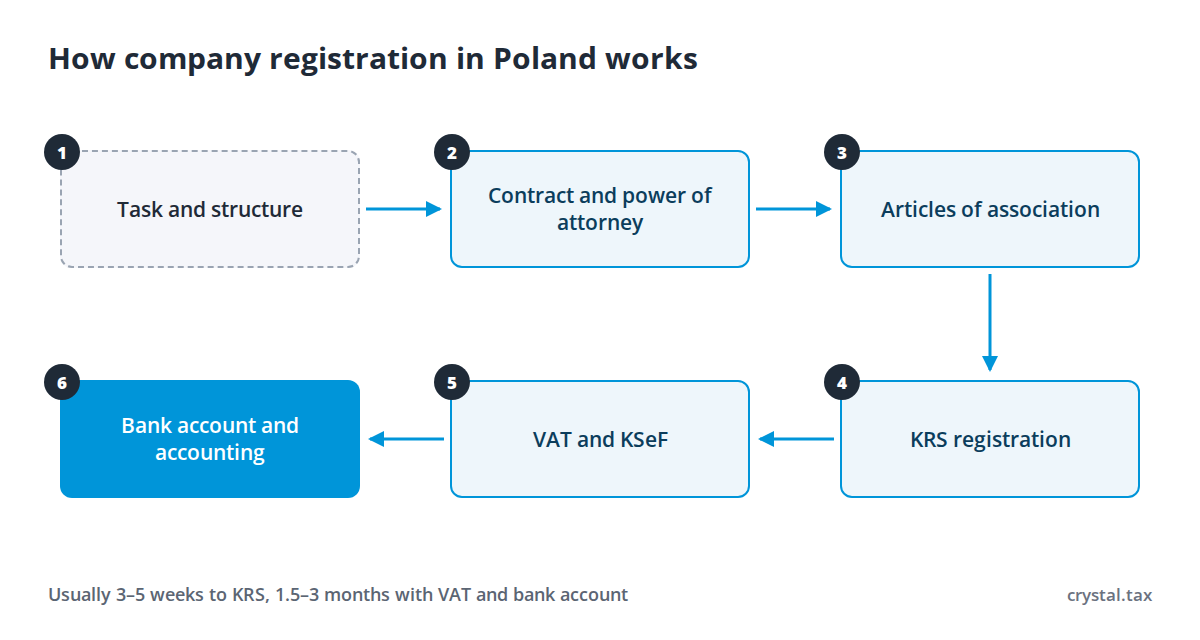
To register a company in Poland, a non-resident needs a passport, the details for the articles of association and, if outside Poland, a notarised power of attorney with a sworn translation into Polish and an apostille where required.
The bank, and the tax office during VAT registration, may ask for more: proof of source of funds, the owner's CV, contracts with the first clients. We tailor the list to your case.
For a non-resident, the main business form in Poland is the sp. z o.o.: any foreigner can set one up, while JDG is open only to those entitled to run a business on the same terms as Polish citizens.
| Criterion | Sp. z o.o. | JDG |
|---|---|---|
| Who can open it | Any foreigner, without a Polish residence permit | EU and EEA citizens, holders of a permanent residence permit, the Karta Polaka and other statuses; Ukrainian citizens with PESEL UKR status |
| Register | KRS, through the court | CEIDG |
| Capital | From PLN 5,000 | None required |
| Liability | Shareholder risks only the contribution | All personal assets |
| Income tax | CIT 19 or 9 percent plus dividend tax | PIT under the chosen tax option |
| Bookkeeping | Full accounting, filings with KRS | Simplified bookkeeping |
Ukrainians and JDG. Since 5 March 2026, Ukrainian citizens with PESEL UKR status or a residence permit granting that right can register a JDG in CEIDG on the same terms as Poles. Holders of UKR status apply through MOS by 4 March 2027 for the three-year CUKR card, which keeps the right to run a business on the same terms. Those who opened a JDG before 5 March 2026 under the earlier simplified rules may continue as long as their stay in Poland is lawful. Without such a status, you can open a business in Poland as a sp. z o.o.
The standard corporate income tax rate for a sp. z o.o. is 19 percent, and the reduced rate is 9 percent for a small taxpayer or a company in its first year of activity if revenue for the tax year does not exceed EUR 2 million; the reduced rate does not apply to capital gains.
| What | Where | Deadline for a calendar tax year |
|---|---|---|
| JPK_V7M with VAT return | Tax office | By the 25th of the following month |
| Beneficial ownership data | CRBR | 14 days after the KRS entry or a change, excluding Saturdays and public holidays |
| Annual financial statements | Draw up, approve, file with KRS | By 31 March, by 30 June, 15 days after approval |
| CIT-8 return | Tax office | By the end of the third month after year end |
A Polish company is by default a Polish tax resident and pays CIT on all its profit. If the owner is a Ukrainian tax resident and controls the sp. z o.o., Ukrainian CFC (controlled foreign company) rules apply: an annual CFC report to the Ukrainian tax authority and a calculation of adjusted profit. Some companies qualify for exemptions, and whether they apply depends on the structure and the figures.
Under the Tax Code of Ukraine, a foreign company is treated as a Ukrainian tax resident if its place of effective management is in Ukraine: board meetings are mostly held in Ukraine, decisions are mainly taken from there, or day-to-day management is run from Ukraine. So before registration we review who sits on the board, where decisions are made and how this is reflected in the documents. If Poland does not fit the task, we compare it with neighbouring EU countries, for example company registration in Hungary, as part of our company registration abroad service.
| Question | Poland | Ukraine |
|---|---|---|
| Who pays tax on profit | The sp. z o.o. itself, CIT | The owner under CFC rules, unless an exemption applies |
| What reporting | JPK, CIT-8, financial statements in KRS | CFC report together with the annual return |
| What to consider | Where the board operates, VAT, KSeF | Share and control, dividends, double taxation |
Describe your task in a few sentences: what the business does, who the owners are, where you live and where your clients are. We will reply within a working day, and on a free 10-minute intro call we will tell you straight away whether a company in Poland or a JDG suits you.
biznes.gov.pl — Limited liability company (Spółka z ograniczoną odpowiedzialnością): basic information; biznes.gov.pl — How to set up a company online in the S24 system; biznes.gov.pl — How a Ukrainian citizen can set up a business in Poland; Act on the National Court Register, consolidated text Dz.U. 2025 item 869, art. 20a; Act on Counteracting Money Laundering, consolidated text Dz.U. 2025 item 644, art. 60 — CRBR deadline; podatki.gov.pl — CIT: rates and limits; podatki.gov.pl — VAT: rates and limits; ksef.podatki.gov.pl — Legal basis and key KSeF deadlines; biznes.gov.pl — Who must file financial statements and when; zakon.rada.gov.ua — Tax Code of Ukraine, para. 133.1.5 and art. 39-2. Checked: 27.09.2026.
Maksym Stepanenko
Managing Partner, Crystal Tax
International client projects since 2012: company structures, tax, immigration, DUNS and NCAGE. 50+ jurisdictions.
“Crystal Tax provided invaluable assistance in setting up our company in the United Arab Emirates…”
Yevelina K.2 years ago · Google Maps
“Opening a bank account abroad sounded scary at first, but Crystal Tax made it super easy. They knew exactly which banks to approach, what paperwork was needed…”
Sergei M.a year ago · Google Maps
“As a fast-growing startup, we needed clear, actionable tax advice — and Crystal Tax delivered exactly that. No jargon, no fluff.”
Inna M.a year ago · Google Maps
Briefly describe your task: the country, the business activity and the timing. That is enough for us to propose a solution and the order of work.
We reply within one business day.
Or message us
 Telegram
 WhatsApp