
Maksym Stepanenko
Managing Partner, Crystal Tax
International client projects since 2012: company structures, tax, immigration, DUNS and NCAGE. 50+ jurisdictions.
Accounting services in the UK for LTD companies with non-resident owners: we keep the books, file with Companies House and HMRC and prepare the Ukrainian CFC report for owners from Ukraine.
Since 2012 · 50+ jurisdictions · Companies House, HMRC and CFC in one team · reply within a working day
In brief
Pick the situation closest to yours: a short route and the first step.
We set up the books from the first month: cloud software, bank feeds, a calendar of Companies House and HMRC deadlines. We check the financial year end and whether VAT registration is needed.
Example. An IT contractor from Kyiv opened an LTD to work with European clients. We connected bookkeeping before the first client invoice and planned the first accounts, which have their own filing deadline.
Discuss this case →We rebuild the books for every missed period from bank statements, file accounts and CT600, and calculate tax and penalties. Where there are grounds, we prepare a penalty appeal.
Example. The owner had filed nothing for two years because the previous accountant stopped replying. We rebuilt both years, filed the returns and removed the risk of the company being struck off the register.
Discuss this case →We set it up as dormant: tell HMRC about the status, file simplified dormant accounts and the confirmation statement. We watch the bank account so that no transactions take the company out of dormant status.
Example. A company was opened for a project that was postponed for a year. We made it dormant, reporting came down to a minimum, and the company stays active on the register.
Discuss this case →We track the 90,000 pound VAT threshold over 12 months, register the company for VAT and file quarterly returns from the software under Making Tax Digital rules.
Example. An online shop started selling to UK buyers. We registered for VAT early, before the threshold was crossed, and set up the books so that returns are generated from the software.
Discuss this case →We prepare the company accounts so they can be attached to the Ukrainian CFC report, translate the financial statements and calculate the adjusted profit together with Crystal Tax lawyers.
Example. The LTD owner is a Ukrainian tax resident. The annual accounts went to Companies House, and then we used them to prepare the CFC report for the owner's tax return.
Discuss this case →We file final accounts and returns, close the tax registrations and then apply to strike the company off the register. If there are assets or debts, we choose a different closure route.
Example. The project ended with a small balance left in the account. First we withdrew the funds and filed the final returns, then applied for strike-off.
Discuss this case →Turnkey accounting services in the UK cover every statutory return of a UK LTD to Companies House and HMRC, plus the owner's Ukrainian CFC reporting. We tailor the scope to the company: minimal for a dormant company, full for a trading company with VAT and staff.

The financial statements a company files in England depend on its size. A micro-entity files the shortest set: a balance sheet and notes. A small company prepares accounts under the small companies regime and can use the audit exemption. A company with no activity files dormant accounts. HMRC receives the accounts and tax computations in iXBRL format together with the CT600, so the version for the tax office is usually more detailed than the one visible on the public register.
The choice of format affects how much information about the company partners and banks will see on the public register. We agree this with the owner in advance, bearing in mind that from 1 April 2028 small companies and micro-entities will also file a profit and loss account with Companies House, with the option to keep it off the public register.
If the UK LTD is part of a group with companies in other countries, we bring its books into our international company accounting service: one set of accounting rules, one deadline calendar, one team.
We rebuild missed reporting from bank statements, invoices and data from the Companies House and HMRC online accounts. We file the oldest periods first, then the current ones, and calculate tax and accrued penalties in parallel. If the delay had a reasonable excuse, we prepare an appeal to HMRC. If Companies House has already sent letters about a possible strike-off for unfiled documents, our first step is to reply to the registrar and file the overdue documents as a priority.
A solvent company is usually closed by striking it off the register. The application is possible if in the last 3 months the company has not traded or sold stock, has not changed its name, is not threatened with liquidation and has no arrangements with creditors. Before applying, we file final accounts and CT600, close VAT and payroll and withdraw the remaining balance: after strike-off, access to the company bank accounts is closed. If the balance sheet holds significant assets or there are debts, we choose a different closure route.
If you do not have a company yet, start with UK company registration: bookkeeping is easiest to set up right after you receive the certificate.
A UK LTD has four key deadlines a year: accounts 9 months after the financial year end, tax 9 months and 1 day after it, CT600 12 months after it and the confirmation statement once a year with a 14-day window. Deadlines set by the authorities are the latest filing dates. We start the work earlier.
By default the accounting reference date falls on the last day of the month in which the anniversary of incorporation falls. The first accounts period can last up to 18 months, while an HMRC accounting period is never longer than 12 months. That is why in the first year a company often has two accounting periods for tax, two CT600 returns and two tax payment dates. The date can be changed, and sometimes that helps: for example, to align the financial year with the calendar year and with Ukrainian CFC reporting. We decide this together with the owner before the first accounts are filed.
An LTD owner who is a Ukrainian tax resident files the CFC report together with the annual personal tax return. For 2025 the deadline was 1 May 2026. If the company's financial statements are not ready by then, a short report is allowed and the full report is filed by 31 December. Acquiring a share, changing it or ending control is reported to the State Tax Service of Ukraine within 60 days. The 9-month UK deadline for accounts often ends later than the Ukrainian one, so for owners from Ukraine we aim to finish the accounts before the official UK deadline.
Usually, in our experience, annual accounts and CT600 for a small company take 3–6 weeks from receipt of statements and documents, and rebuilding one missed year takes 4–8 weeks. The timeline depends on the case, its details, the work of the authorities and force majeure. Monthly bookkeeping and quarterly VAT follow an agreed schedule; we ask for the quarter's documents within the first two weeks after it ends.
We price UK accounting individually, based on transaction volume and the set of returns. We do not publish packages or prices, because two LTDs with the same turnover can need very different amounts of work.
The estimate depends on:
For companies with missed periods, we first estimate the catch-up work and then ongoing service. This way the owner sees what it costs to close past years and what the work costs going forward.
Government fees and penalties are paid separately. We will give you an estimate within a working day after a short description of the task.
We look after clients' UK companies together with their banks, their taxes in Ukraine and the rest of their structure.
We work in 50+ jurisdictions. We know the requirements of Companies House, HMRC and UK banks from our own cases.
Correspondence with Companies House and HMRC, replies to enquiries and penalty letters are on us. From you we need documents and decisions.
If the registrar or the tax office returns a filing with remarks, we rework it at no extra charge.
Company, account, bookkeeping, taxes, including Ukrainian CFC rules: no need to look for separate contractors.
We work under a contract, and confidentiality terms are set out in it. Only the people who keep your books have access to your company data.
UK LTD accounting for non-residents is organised so that all we need from you is bank statements and decisions.
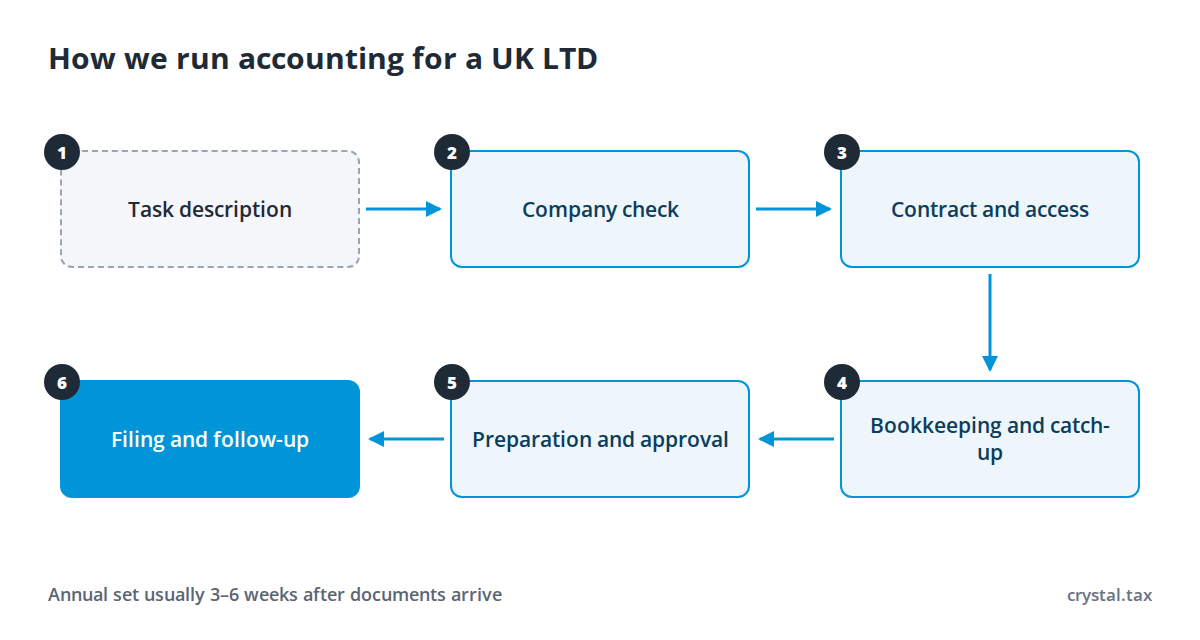
For accounting services in the UK, the basis is bank statements for the period and documents for large transactions. Anything else we request as the work goes on.
We accept documents electronically in Russian, Ukrainian or English. If a transaction has no supporting document, we help to restore it or record the transaction correctly, so the question does not come up in an HMRC check or a bank enquiry.
When the accountant changes, we request working files and ledgers from the previous agent. If they cannot be reached, we rebuild the picture from Companies House data, the company's HMRC online account and bank statements.
All directors and PSCs must verify their identity with Companies House and receive a personal code. The confirmation statement cannot be filed without the codes of all directors, so we check this at the start of the work.
| Return | Filed with | Deadline | Who files |
|---|---|---|---|
| Annual accounts | Companies House | 9 months after the accounting reference date, first accounts 21 months from incorporation | all companies, including dormant |
| Confirmation statement | Companies House | every 12 months, 14-day window | all companies, including dormant |
| CT600 | HMRC | 12 months after the end of the accounting period | all companies, except dormant ones unless HMRC requests a return |
| Corporation Tax payment | HMRC | 9 months and 1 day after the end of the period | companies with tax to pay |
| VAT return | HMRC | usually 1 month and 7 days after the quarter | VAT-registered businesses |
| Payroll FPS | HMRC | on or before payday | employers |
| CFC report | State Tax Service of Ukraine | with the annual personal tax return, for 2025 by 1 May 2026 | owners who are Ukrainian tax residents |
Since 1 April 2023 the Corporation Tax rate depends on profits. The 50,000 and 250,000 pound thresholds are divided by the number of associated companies and reduced for short accounting periods, so the calculation differs for an owner of several companies.
| Annual profits | Rate |
|---|---|
| up to 50,000 pounds | 19 percent, small profits rate |
| 50,000 to 250,000 pounds | 25 percent with marginal relief |
| over 250,000 pounds | 25 percent, main rate |
VAT registration is mandatory if taxable turnover over the last 12 months exceeded 90,000 pounds or is expected to exceed it in the next 30 days. After crossing the threshold, a business has 30 days from the end of that month to register. With rare exceptions, VAT-registered businesses keep digital records and file returns through compatible software under Making Tax Digital rules.
Since 6 April 2025 the company size thresholds have been raised. The category is set by two of three criteria.
| Category | Turnover | Balance sheet | Employees |
|---|---|---|---|
| Micro-entity | up to 1 million pounds | up to 500,000 pounds | up to 10 |
| Small company | up to 15 million pounds | up to 7.5 million pounds | up to 50 |
Small companies and micro-entities can use the audit exemption. An audit is still required for certain categories, such as public companies, banks and insurers, so we check eligibility for the exemption for each company.
Nil returns for a UK LTD are called dormant company accounts. A company with no activity and no income files simplified accounts without a profit and loss account, plus the confirmation statement. Once HMRC has been told the company is dormant, no CT600 is due until HMRC sends a new notice to file.
Companies House late filing penalties for private company accounts: up to 1 month late 150 pounds, 1 to 3 months 375 pounds, 3 to 6 months 750 pounds, more than 6 months 1,500 pounds. If accounts are late two years in a row, the penalty is doubled.
HMRC penalties for a late CT600: 200 pounds on the first day and another 200 pounds after 3 months. After 6 months HMRC estimates the tax itself and adds 10 percent of the unpaid tax, and after 12 months another 10 percent. If the return is late three times in a row, the fixed penalties rise to 1,000 pounds each.
The Economic Crime and Corporate Transparency Act, ECCTA, is changing the rules step by step. Since 18 November 2025 identity verification of directors and PSCs has been mandatory, with a 12-month transition period for existing directors. From 1 April 2028 accounts can only be filed through commercial software in iXBRL format, abridged accounts are abolished, and small companies and micro-entities will file a profit and loss account with Companies House, with the option to keep it off the public register.
Describe your company and task: within a working day we will reply with an estimate and a list of documents. If you prefer to talk, we can start with a free 10-minute call.
GOV.UK: Life of a company, annual requirements, accounts; GOV.UK: Late filing penalties for annual accounts; GOV.UK: Company Tax Returns and late filing penalties; GOV.UK: Corporation Tax rates and reliefs; GOV.UK: Pay your Corporation Tax bill; GOV.UK: Confirmation statement guidance; GOV.UK: Companies House identity verification from 18 November 2025; GOV.UK: VAT registration threshold; HMRC: VAT Notice 700/22 Making Tax Digital for VAT; Tax Code of Ukraine, Article 39-2 and subparagraph 49.18.4: CFC report, deadlines. Checked: 27.09.2026.
Maksym Stepanenko
Managing Partner, Crystal Tax
International client projects since 2012: company structures, tax, immigration, DUNS and NCAGE. 50+ jurisdictions.
“Crystal Tax provided invaluable assistance in setting up our company in the United Arab Emirates…”
Yevelina K.2 years ago · Google Maps
“Opening a bank account abroad sounded scary at first, but Crystal Tax made it super easy. They knew exactly which banks to approach, what paperwork was needed…”
Sergei M.a year ago · Google Maps
“As a fast-growing startup, we needed clear, actionable tax advice — and Crystal Tax delivered exactly that. No jargon, no fluff.”
Inna M.a year ago · Google Maps
Briefly describe your task: the country, the business activity and the timing. That is enough for us to propose a solution and the order of work.
We reply within one business day.
Or message us
 Telegram
 WhatsApp