
Maksym Stepanenko
Managing Partner, Crystal Tax
International client projects since 2012: company structures, tax, immigration, DUNS and NCAGE. 50+ jurisdictions.
Kenya company registration for foreign founders, turnkey: we set up your private company or branch with the Business Registration Service remotely, provide the Kenya-resident contact person the law requires through licensed partners, register the company and its directors with KRA and keep the books.
Since 2012 · 50+ jurisdictions · registration without a trip to Nairobi · accounting and CFC reporting in one team
In brief
Pick the situation closest to yours: a short outline of the route and the first step.
We register a private company limited by shares with you as sole owner and director. You have your passport copy certified by a notary, we obtain your KRA PIN through a tax agent, and the contact person or company secretary the law requires when there is no resident director is provided through licensed partners in Kenya.
Example. A SaaS founder from Poland opened a company in Nairobi to work with local distributors; the sole owner and director lives in Europe.
Discuss this case →We register a foreign company with BRS and obtain the certificate of compliance. We prepare notarised and translated documents of the parent company and provide the office address and the Kenya-resident local representative the law requires through licensed partners in Kenya.
Example. A logistics company from the UAE registered a Kenyan branch for a contract at the port of Mombasa and set up VAT and payroll compliance right away.
Discuss this case →We compare a private company, a branch and an LLP by liability, tax and the people required in Kenya. For most foreign founders a private company is simpler: one shareholder and one director are enough.
Example. Two partners from Ukraine and Canada weighed an LLP against a company; because an LLP needs a Kenya-resident manager, they chose a private company.
Discuss this case →We check whether significant economic presence tax and a Kenyan VAT registration apply to you. Then we calculate whether it pays to stay under this regime or open a Kenyan company.
Example. An online school from Europe sold courses to Kenyan students; after the calculation the owner registered for VAT as a non-resident and postponed the company until hiring a team.
Discuss this case →We check the BRS register entry, file annual returns and beneficial ownership information, update director and contact person details and reconcile liabilities in iTax.
Example. The owner of a company registered in 2019 found it on the BRS list of companies the registrar believed were not carrying on business; within a few weeks the company was back in good standing.
Discuss this case →We register the company and set up the Ukrainian side from the start: the CFC notification, the annual CFC report and the tax calculation under Ukrainian CFC (controlled foreign company) rules. We decide early where the company will be managed, so that it does not become tax resident somewhere you did not plan.
Example. An IT entrepreneur from Dnipro opened a Kenyan company for a project with a local telecom operator; one team handles the CFC report in Ukraine and the accounting in Kenya.
Discuss this case →Turnkey Kenya company registration covers everything a working company needs: structure, BRS registration, tax registration with KRA, the people the law requires and preparation for the bank. You send documents and make decisions, and we do the rest.

A foreign-owned company can open an account with a Kenyan bank, but the bank reviews the business, the source of funds and the owners and may ask for an in-person meeting. The bank makes the decision. We choose a bank that fits the company profile, prepare the business description, payment flow and source-of-funds documents, and support the application until the decision.
Registering a company does not by itself give the right to live and work in Kenya. A director or owner who will work in Kenya in person needs a work permit issued by the Directorate of Immigration Services through the eFNS portal; KRA, for example, issues a PIN to a foreign employee only with a valid permit. We arrange permits through partners, see business relocation and residence permits for details.
A foreign investor may obtain a Kenya Investment Authority certificate on a voluntary basis when investing at least 100,000 US dollars. It entitles the holder to the licences listed in the certificate and to permits for some employees and owners. We decide whether you need it based on your investment and hiring plan.
Accounting is a mandatory part of running a Kenyan company from the first month, even with no revenue yet: KRA expects nil returns and BRS expects annual returns. The lawyers and accountants of Crystal Tax, together with partners in the country, take care of:
If Kenya does not fit your task, we compare it with other countries on the page company registration abroad.
Usually, in our experience, Kenya company registration with a KRA PIN and a contact person takes 2–4 weeks from signing the contract, and the full launch including a bank account takes 1–3 months. The timeline depends on the case, its details, the authorities and force majeure.
The official BRS timeframe covers only the review of a complete application. Notarisation, translations, PINs and bank checks take extra time.
Timelines get longer in predictable situations: the shareholder is a company from another country and notarised documents are needed along the whole chain; documents are not in English and require a certified translation; the activity is licensed. We name these points at the start so you can plan the launch with a buffer.
After registration the company has its own dates: monthly returns in iTax from the first month, the annual return on the anniversary of registration, financial statements within 9 months after the end of the financial year and the IT2C return within 6 months. Changes in beneficial ownership are filed with BRS within 14 days. We hand over a calendar with these dates together with the company documents.
We quote the cost of Kenya company registration individually: it depends on the business form, the number of participants and what you need beyond the registration itself.
BRS government fees and notary costs are paid separately at official rates, and we name them in advance. Describe your task in a few sentences and we will estimate the work within a working day. If you need a detailed review of the structure, a 30-minute consultation is available for 100 euros.
Five reasons foreign founders set up business in Kenya with us.
We work in 50+ jurisdictions; we know the requirements of registrars, banks and tax authorities from our own cases, and in Kenya we work together with partners in the country.
Correspondence with BRS, KRA and the bank and replies to their queries are our job. From you we need documents and decisions.
If the registrar, the tax authority or the bank sends queries, we resolve them at no extra charge.
Company, contact person, bank account, accounting, Kenyan taxes and Ukrainian CFC reporting, with no need to find separate contractors.
We work under a contract, and the confidentiality terms are written into it.
Kenya company registration runs in six steps, and at each one you know what is needed from you.
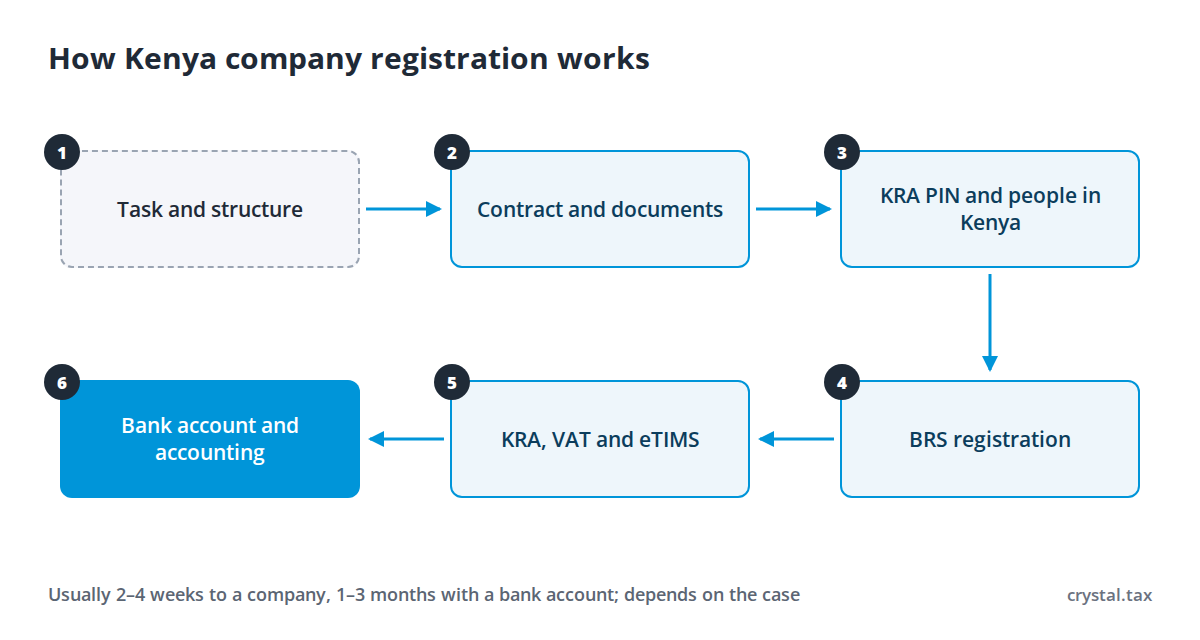
To register a company in Kenya, a foreigner needs a notarised copy of the passport data page, a photo and contact details; a corporate shareholder needs a notarised certificate of incorporation from its home country.
Foreign founders most often choose between a private company and a branch; an LLP or a public company is needed less often. Below are the requirements under the Companies Act 2015, the LLP Act and BRS data as of 27.09.2026.
| Form | Members and management | Who is needed in Kenya | What BRS issues |
|---|---|---|---|
| Private company limited by shares | 1 to 50 shareholders, at least 1 director, at least one director must be an individual aged 18 or over | Contact person, company secretary or advocate if there is no resident director; a company secretary is mandatory with paid-up capital of 5 million shillings or more | Certificate of incorporation |
| Public limited company | At least 2 directors, shares may be offered to the public | Company secretary with a practising certificate under the Certified Public Secretaries of Kenya Act | Certificate of incorporation |
| Limited liability partnership | At least 2 partners | Manager: an individual aged 18 or over, resident in Kenya | Certificate of incorporation |
| Foreign company, branch | Foreign company, no local shareholding required | Local representative resident in Kenya, office open during the hours notified to the registrar | Certificate of compliance |
The BRS government fee for registering a private company, according to BRS practice note PN/01, is 10,750 shillings, including name reservation and the eCitizen fee. Registering a branch of a foreign company, according to note PN/07, costs 7,550 shillings. BRS fees change, so we check the current amount before filing.
All companies and LLPs keep a beneficial ownership register and file a copy with BRS; changes are filed within 14 days. Under the Companies Act, late filing of changes attracts an administrative penalty of 2,000 shillings plus 100 shillings for each day, and failure to file the register carries a fine of up to 500,000 shillings. The registrar may strike off companies that do not file.
A company incorporated under Kenyan law is tax resident in Kenya; a foreign company also becomes resident if its management and control are exercised in Kenya. The rates below follow the Income Tax Act and the VAT Act as in force from 1 July 2026 and KRA pages.
| Tax | Rate or rule |
|---|---|
| Corporate income tax, resident company | 30 percent |
| Corporate income tax, branch of a foreign company | 30 percent since 2024; a further 15 percent on profit repatriated to the head office |
| Dividends paid to a non-resident | 15 percent withholding, a double tax treaty may reduce the rate |
| Management and consultancy fees paid to a non-resident | 20 percent withholding |
| VAT | 16 percent, registration mandatory once taxable supplies reach 5 million shillings in 12 months |
| Turnover tax for residents | 1.5 percent of gross turnover for annual turnover above 1 million and up to 25 million shillings, with an option to opt out on application |
| Significant economic presence tax | For non-residents providing digital services to users in Kenya: 30 percent of deemed profit equal to 10 percent of turnover |
| Minimum tax | Repealed by the Finance Act 2025 |
Since 2024, expenses reduce taxable profit only if supported by electronic invoices from eTIMS, subject to the exceptions in the Tax Procedures Act. That is why every operating company needs eTIMS, even without VAT registration.
For an owner who is a Ukrainian tax resident, the profit of a Kenyan company may be taxed in Ukraine under Ukrainian CFC rules, and we take this into account when choosing the structure.
Accounting for a Kenyan company means monthly returns to KRA through iTax, electronic invoices in eTIMS and annual filings with BRS. We handle it after registration so that deadlines and data at both agencies match.
| Obligation | Deadline |
|---|---|
| PAYE for employees | By the 9th of the following month; a nil return is filed if there are no employees |
| VAT return | By the 20th of the following month |
| Corporate income tax instalments | Four instalments of 25 percent each by the 20th day of the 4th, 6th, 9th and 12th month of the year |
| Annual IT2C return | By the end of the 6th month after the end of the financial year |
| Annual return to BRS | Made up to the anniversary of registration and filed within 28 days |
| Financial statements to BRS | For a private company, within 9 months after the end of the financial period |
| Changes in beneficial owners, directors, shareholdings | Within 14 days for beneficial owners, within BRS deadlines for other events |
An audit is not mandatory for a small company with annual turnover of up to 50 million shillings and net assets of up to 20 million shillings. Banks and investors often ask for audited statements even without a mandatory audit, and we factor this into planning.
A branch of a foreign company files the financial statements of its parent company with BRS once a calendar year, together with a statutory declaration verifying the copies, and reports to KRA on the profit earned in Kenya.
Describe your task in a few sentences: what the business does, who the owners are and where the clients are. We will reply within a working day, and on a free 10-minute call we will tell you right away whether a company in Kenya suits you.
Kenya Law — Companies Act, Cap 486, as at 27.12.2024; BRS — Practice Note PN/01 Incorporation of Companies, v2.0; BRS — Practice Note PN/07 Foreign Companies, v2.0; Kenya Law — Income Tax Act, Cap 470, as at 01.07.2026; Kenya Law — Value Added Tax Act, as at 01.07.2026; Kenya Law — Limited Liability Partnership Act, Cap 30; Kenya Law — Investment Promotion Act, Cap 485; KRA — Companies and Partnerships: filing and paying taxes; KRA — Requirements for KRA PIN registration; KRA — What is eTIMS. Checked: 27.09.2026.
Maksym Stepanenko
Managing Partner, Crystal Tax
International client projects since 2012: company structures, tax, immigration, DUNS and NCAGE. 50+ jurisdictions.
Briefly describe your task: the country, the business activity and the timing. That is enough for us to propose a solution and the order of work.
We reply within one business day.
Or message us
 Telegram
 WhatsApp