
Maksym Stepanenko
Managing Partner, Crystal Tax
International client projects since 2012: company structures, tax, immigration, DUNS and NCAGE. 50+ jurisdictions.
US trademark registration, turnkey, for brand owners from Ukraine and other countries: we check your mark, file with the USPTO through a US-licensed partner attorney and take the application through to registration.
Since 2012 · 50+ jurisdictions · USPTO filing through US partner attorneys · EU and Madrid System in one team
In brief
Pick the situation closest to yours: a short note on the route and the first step.
Amazon Brand Registry accepts a brand with a registered trademark or a pending application filed with the office of the country where the Amazon store operates. We check the mark and file with the USPTO, and the application number can be used to enrol in Brand Registry.
Example. A kitchenware manufacturer from Dnipro filed a USPTO application for a word mark in one class and enrolled the brand in Brand Registry while the application was pending.
Discuss this case →We check the name against the USPTO register and the market, choose classes for software and online services, and pick the filing basis: actual use or intent to use.
Example. An IT team from Kharkiv filed in two classes ahead of a funding round; the investor checked for the application during due diligence.
Discuss this case →We compare two routes: designating the US through the Madrid System based on the Ukrainian registration, or a direct USPTO application. If less than 6 months have passed since the Ukrainian filing date, priority can be claimed.
Example. A furniture maker with a mark registered in Ukraine chose a direct USPTO application: it made it easier to word the goods precisely for the US market.
Discuss this case →We take over the case: a partner attorney enters an appearance, we analyse the examiner's objections and prepare the response within the deadline. If the deadline is close, we assess an extension.
Example. A cosmetics brand owner received a refusal over the description of goods after filing through an online service; the response reworded the goods, and the application was published.
Discuss this case →We file with the USPTO and EUIPO in parallel, or through the Madrid System, with the same list of goods. One team keeps the deadlines and correspondence for both applications.
Example. A children's clothing brand from Lviv filed in the US and the EU at the same time before launching on marketplaces in both regions.
Discuss this case →We assess the risk: similarity of the marks, relatedness of the goods, actual use of the other mark. We propose options: change the name or logo, narrow the list of goods, or agree coexistence with the owner.
Example. A fitness start-up found a similar mark in a neighbouring class on the register and changed its name before filing, keeping the recognisable part of the brand.
Discuss this case →Turnkey US trademark registration covers everything from checking the mark to the registration certificate and a renewal calendar. Applications and responses are filed with the USPTO through licensed partner attorneys in the US; for you it is one contract and one team, and we run the correspondence.

Federal registration with the USPTO secures rights to the mark in every state, puts them on the public register and lets you use the ® symbol next to the mark; before registration the TM designation is used. Registration is needed to enrol a brand on marketplaces, for licence agreements with distributors and when an investor reviews the company. A brand already sold in the US without registration is exposed: a competitor can file for a similar mark first, and a dispute costs more than registration.
EU trademark registration goes through EUIPO and gives one mark for all 27 EU member states. The application can be filed in parallel with the US one or through the Madrid System. Applicants from outside the European Economic Area must be represented by a professional representative in the EU in proceedings after filing; we work through professional representatives in the EU who are our partners.
If you sell in the US through your own company, we handle company registration in the USA and decide who will own the mark: you personally, a Ukrainian company or a US company. Licences, taxes and reporting under the Ukrainian CFC (controlled foreign company) rules depend on this choice.
Usually, in our experience, the search and USPTO filing take 1–2 weeks from signing the contract, and the whole US trademark registration usually takes about a year or longer. The timeline depends on the case, its details, the authorities and force majeure.
The USPTO target for total pendency is 11 months on average, excluding suspended applications and proceedings. This is the office's benchmark for examination; time for the search, responses to the examiner and any opposition is added to it.
Timelines grow longer in predictable cases: the examiner finds a similar mark in an earlier application and suspends examination, asks for clarification of the goods, or a third party files an opposition. For an intent-to-use application the time to registration depends on when you start selling in the US. We name these points at the start so that you can plan the brand launch with a margin.
We calculate the cost of US trademark registration individually: it consists of our work, the partner attorney's work and USPTO government fees, which depend on the number of classes.
USPTO government fees are paid separately at the official rates, listed in the reference section below. Describe your brand, goods and sales countries in a few sentences, and we will estimate the work within a working day. If you need a detailed review of your brand protection strategy, a 30-minute consultation is available for 100 euros.
Five reasons brand owners protect their marks in the US with us.
We work in 50+ jurisdictions; we know the requirements of offices, registrars and banks from our own cases, including the 2025 USPTO changes.
Applications and responses are filed with the USPTO through licensed partner attorneys in the US. For you it is turnkey: we run the correspondence, and we need brand details and decisions from you.
If a USPTO or EUIPO examiner sends objections, we rework them with no extra charge for our work. The registration decision rests with the office, and we give an honest risk assessment before filing.
Trademark, US company, contracts, taxes and reporting, including Ukrainian CFC (controlled foreign company) reports, with no need to find separate contractors.
We work under a contract with confidentiality terms written into it. Details of a new brand stay between us until filing.
To register a trademark in the US we go through six steps, and at each one you know what we need from you.
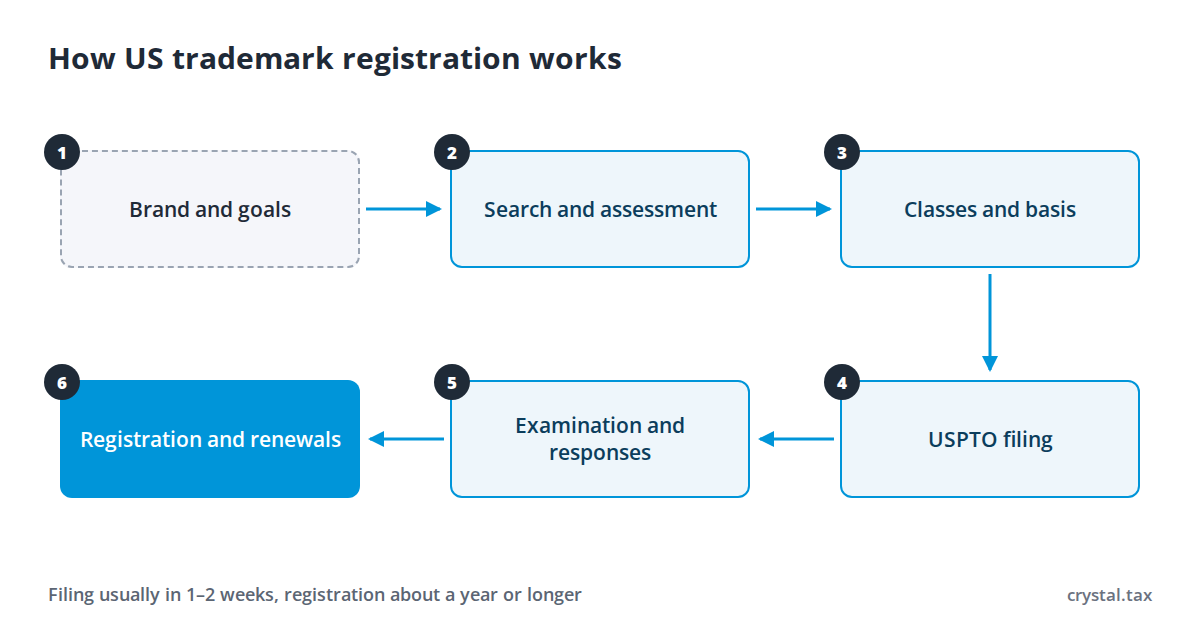
To register a trademark in the US you need applicant details, an image of the mark and a list of goods; notarised documents and an apostille are usually not required for a USPTO application.
A USPTO application is filed on one or more bases, and the basis determines what is needed before registration.
| Basis | When it fits | What is needed before registration |
|---|---|---|
| Section 1(a), use in commerce | Goods bearing the mark are already sold in the US or in commerce with the US | Date of first use and a specimen of use at filing |
| Section 1(b), intent to use | No US sales yet, the brand is preparing to launch | After the notice of allowance, a Statement of Use within 6 months or extensions |
| Section 44(d), foreign application priority | No more than 6 months have passed since the filing date in another country | Foreign registration, use or intent to use as a second basis |
| Section 44(e), foreign registration | The mark is already registered in the applicant's country | Copy of the foreign registration |
| Section 66(a), Madrid System | The US is designated in an international application through WIPO | Examination at the USPTO on general grounds |
USPTO fees are government charges paid separately from our work. The new fee structure has applied since 18 January 2025; the former TEAS Plus and TEAS Standard options were replaced by one base application with surcharges. Amounts under the official USPTO fee schedule as of 27.09.2026, in US dollars per class:
| Action | Fee |
|---|---|
| Base application, electronic filing | 350 |
| Surcharge for insufficient information in the application | 100 |
| Surcharge for a free-form description of goods | 200 |
| Surcharge for each additional 1000 characters of description | 200 |
| Statement of Use | 150 |
| Extension of time for the Statement of Use | 125 |
| Section 8 declaration | 325 |
| Section 9 renewal | 325 |
| Grace period surcharge, Section 8 or Section 9 | 100 |
| Extension of time to respond to an office action, per application | 125 |
When the US is designated through the Madrid System, an individual fee is charged through WIPO; according to the USPTO, since 18 February 2025 it is the equivalent of 600 US dollars per class. We calculate the exact fees for your list of goods before filing.
Most USPTO examiner objections repeat from one application to the next, and many of them can be prevented at the preparation stage.
| Reason | What it means | How we reduce the risk |
|---|---|---|
| Likelihood of confusion | The register holds an earlier mark similar in sound, appearance or meaning for related goods | Search before filing; if there is a risk, we change the mark or narrow the goods |
| Descriptive mark | The word directly describes the product, its quality or purpose | We choose a more distinctive name or register a logo |
| Imprecise description of goods | The wording is too broad or unclear for the examiner | We use wording from the USPTO ID Manual |
| Unacceptable specimen | The photo or screenshot does not show the mark with the goods or a way to order | We check specimens before filing and in the response |
| Foreign-language words | The examiner requires a translation and assesses the meaning of the word in English | We provide the translation in the application from the start |
An office action response is a legal document with arguments and references to case law, so the US attorney prepares it together with us. We explain the substance of the objection to you in plain language and propose options: argue, amend the goods or change the mark.
After registration the mark is worth protecting actively: watch for similar applications from competitors, keep evidence of use of the mark in the US and file declarations on time. If the brand is used without permission on a marketplace or in dealings with distributors, we bring in legal support for international business: demand letters, licence agreements, negotiations.
International trademark registration is possible in two ways: national applications in each country, or the WIPO Madrid System based on an application or registration in your home country. Ukraine has been party to the Madrid Protocol since 29 December 2000, the US since 2 November 2003.
| Criterion | Direct USPTO application | US designation through the Madrid System | EU trademark, EUIPO |
|---|---|---|---|
| Territory | US | US and other designated countries | 27 EU countries |
| Base | Not required | Application or registration in the country of origin | Not required |
| Representative | US attorney for foreign applicants | US attorney for USPTO responses | Professional representative in the EU for applicants outside the EEA after filing |
| Response period | 3 months plus one 3-month extension | 6 months, no extension | Set by EUIPO in the notice |
| Opposition | 30 days after publication | 30 days after publication | 3 months after publication |
| Term | 10 years with renewal, declarations of use | 10 years, renewal through WIPO | 10 years with renewal |
The Madrid System is convenient when you need several countries and the mark is already registered at home. A direct USPTO filing gives more freedom in wording the goods and does not depend on the fate of the base application. The EUIPO fee for an EU trademark filed electronically is 850 euros for one class, 50 euros for the second and 150 euros for the third and each further class, under Annex I to Regulation (EU) 2017/1001. We choose the route for your list of countries and goods; trademark registration in other countries abroad, for example trademark registration in Canada, is handled by the same team.
Describe your brand, goods and the countries where you sell or plan to sell. We reply within a working day, and on a free 10-minute call we tell you which US trademark registration route suits you.
USPTO — Trademark fee schedule; USPTO — Summary of 2025 trademark fee changes; eCFR — 37 CFR 2.11, Requirement for representation; Federal Register, 2019 — Requirement of U.S. licensed attorney for foreign trademark applicants and registrants; USPTO — Keeping your registration alive; USPTO — Trademarks dashboard, pendency targets; eCFR — 37 CFR 2.62 and 2.89, office action response and Statement of Use deadlines; WIPO Lex — Madrid Protocol contracting parties; Amazon — Brand Registry requirements; EUR-Lex — Regulation (EU) 2017/1001 on the EU trade mark, Articles 46, 52, 119 and Annex I. Checked: 27.09.2026.
Maksym Stepanenko
Managing Partner, Crystal Tax
International client projects since 2012: company structures, tax, immigration, DUNS and NCAGE. 50+ jurisdictions.
“Crystal Tax provided invaluable assistance in setting up our company in the United Arab Emirates…”
Yevelina K.2 years ago · Google Maps
“Opening a bank account abroad sounded scary at first, but Crystal Tax made it super easy. They knew exactly which banks to approach, what paperwork was needed…”
Sergei M.a year ago · Google Maps
“As a fast-growing startup, we needed clear, actionable tax advice — and Crystal Tax delivered exactly that. No jargon, no fluff.”
Inna M.a year ago · Google Maps
Briefly describe your task: the country, the business activity and the timing. That is enough for us to propose a solution and the order of work.
We reply within one business day.
Or message us
 Telegram
 WhatsApp